Introduction
Modern travel often involves carrying more small electronic accessories than expected. A phone may need a charging cable, a laptop may require a power adapter, wireless earbuds may need their charging case, and other devices can introduce USB adapters, memory cards, data cables, and accessories. When these items are placed loose inside a backpack or suitcase, finding the right cable or adapter can become surprisingly inconvenient.
An electronics organizer case provides a simple way to bring some structure to this collection of small accessories. Instead of placing cables, memory cards, chargers, and adapters together in a single pocket, an organizer can give each category a more defined place.
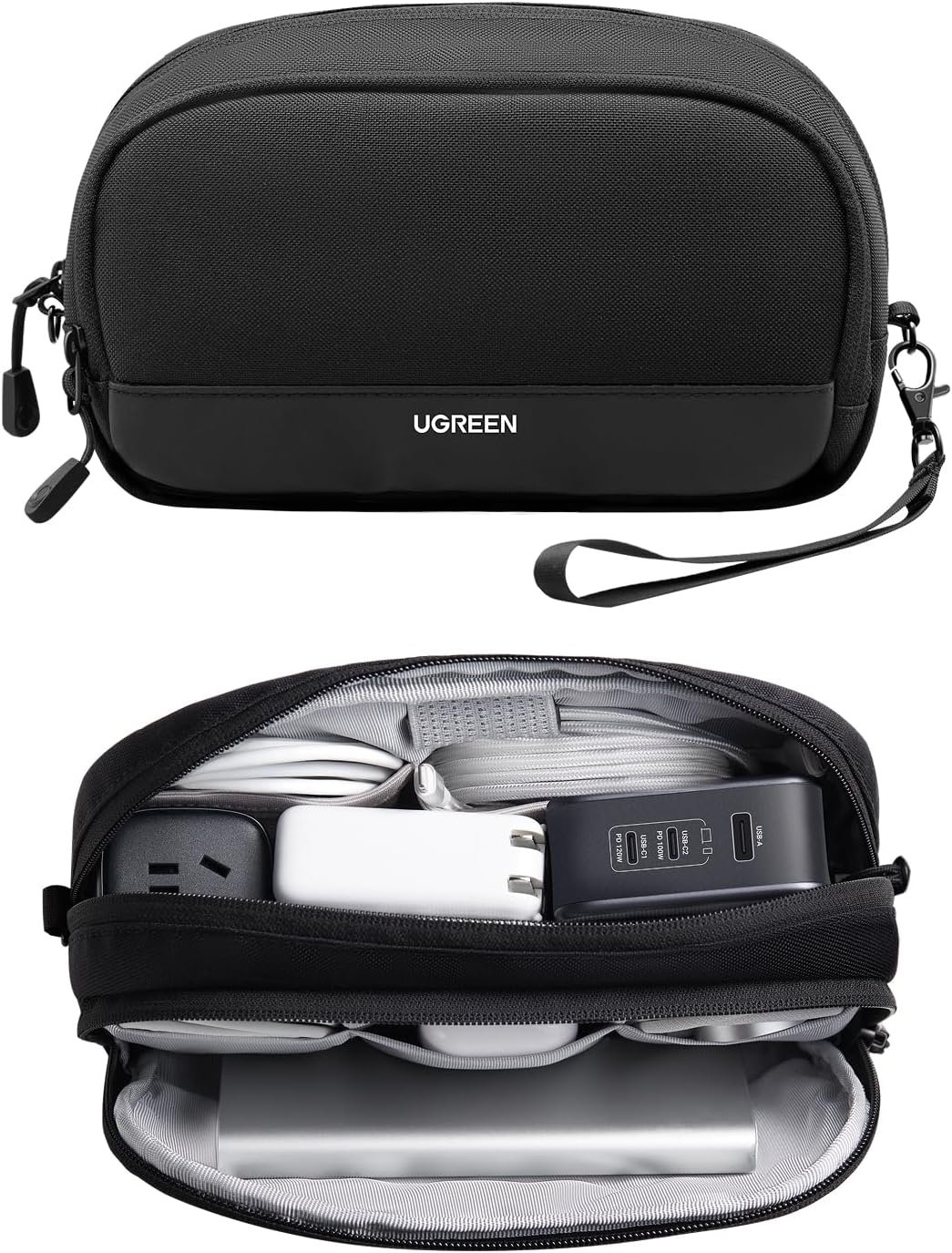
The UGREEN Electronics Organizer Travel Case is a medium-sized carrying case designed for electronic accessories such as cables, cords, SD cards, earbuds, chargers, USB adapters, and related items. Its purpose is not to replace a backpack or laptop bag, but to create a dedicated organizational layer inside one.
This distinction is useful. An electronics organizer is primarily about organization, portability, and access. It can help reduce loose accessories moving around inside a larger bag while making it easier to identify what is being carried.
The UGREEN case can be relevant to travelers, remote workers, students, photographers, commuters, and anyone who regularly carries multiple electronic accessories. At the same time, an organizer is not equally useful for every person. Someone who only carries a phone and one charging cable may have little need for a dedicated case, while someone carrying several devices may benefit much more from a structured storage solution.
This guide examines the UGREEN Electronics Organizer Travel Case from an informational perspective. It covers the main characteristics of this type of organizer, practical ways to use it, what to consider before choosing one, and how an electronics organizer compares with simpler storage options.
What Is an Electronics Organizer Travel Case?
An electronics organizer travel case is a compact storage solution designed specifically for small technology accessories.
Unlike a standard pouch, which may provide one open compartment, an electronics organizer generally divides the interior into multiple sections. Depending on the particular design, these areas may accommodate cables, memory cards, small adapters, chargers, earbuds, and other accessories.
The idea is simple: instead of storing everything together, the user can organize accessories according to size, type, or frequency of use.
This can be particularly helpful when traveling.
A loose collection of charging cables and adapters can quickly become difficult to manage inside a backpack. Cables may become tangled, small memory cards can be difficult to locate, and adapters can disappear underneath larger objects.
A dedicated organizer provides a separate place for these items.
Key Features of the UGREEN Electronics Organizer
Dedicated Storage for Electronic Accessories
The primary purpose of the UGREEN organizer is to hold small technology accessories.
The listed product is designed for items including:
- Charging cables
- Data cables
- Cords
- SD cards
- Earbuds
- Chargers
- USB adapters
- Small electronic accessories
This range makes the case suitable for people who carry several different types of technology accessories rather than only one or two items.
The exact amount that can be stored will depend on the size and shape of the accessories.
Medium-Size Format
The product is described as a medium-sized organizer.
A medium format can provide a practical balance between storage capacity and portability.
A very small organizer may be convenient to carry but can become restrictive when several chargers and cables need to be stored. On the other hand, a large electronics case can become bulky, particularly when the user only needs to carry a modest collection of accessories.
The medium category is therefore relevant for users who want more structure than a small pouch without necessarily carrying a large equipment case.
Multiple Accessory Categories
An electronics organizer is most useful when its interior layout matches the types of items the user carries.
Cables can take up space differently from memory cards or earbuds. A good organization system allows different accessories to remain separated instead of becoming one tangled collection.
For example, a traveler might dedicate one area to charging cables, another to USB adapters, and another to removable storage.
This kind of organization can make the case easier to use even when the user is carrying many small accessories.
Travel-Oriented Design
The product is specifically positioned as a travel case.
Travel introduces several challenges for small electronics accessories.
Items are frequently moved between backpacks, carry-on luggage, hotel rooms, offices, and other locations. Without a consistent storage place, small accessories can easily be left behind.
A dedicated organizer creates one location where these accessories can be stored during transport.
That can make packing and unpacking more systematic.
Why Cable Organization Matters
Cables are among the easiest technology accessories to accumulate.
A person may have separate cables for:
- A smartphone
- A tablet
- A laptop
- Wireless earbuds
- A portable battery
- A camera
- Other USB-powered devices
Even when the cables look similar, they may serve different purposes.
Some may support charging only, while others may support data transfer. Some may have different connectors or lengths.
When several cables are stored together without organization, identifying the correct one can take time.
A dedicated electronics organizer can provide separate spaces for cables, making it easier to retrieve a particular accessory without emptying an entire bag.
How It Can Be Used for Travel
Travel is one of the most obvious applications for an electronics organizer.
Carry-On Organization
A traveler can place commonly needed technology accessories in the organizer and keep it inside a carry-on bag.
Instead of searching through several pockets for a charging cable or adapter, the user has one dedicated case to open.
This can be particularly useful during airport travel, train journeys, or long-distance trips where access to chargers and cables may be necessary.
Hotel and Accommodation Use
Once at a hotel or other accommodation, the organizer can remain as a central location for electronic accessories.
Rather than scattering cables across a bedside table, desk, or luggage compartment, users can return them to the case when they are finished.
This creates a consistent routine that can reduce the possibility of accidentally leaving an accessory behind.
Packing and Unpacking
The case can also simplify packing.
Instead of collecting individual cables and accessories one by one, the organizer can be packed as a single unit.
When the trip ends, the same case can be placed back into the larger bag.
Use for Remote Work
Remote workers often carry a collection of accessories between home, office, cafés, coworking spaces, and temporary work locations.
A typical setup might include:
- Laptop charging accessories
- USB cables
- USB adapters
- Memory cards
- Earbuds
- Portable storage
- Phone charging accessories
Keeping these items in one organizer can make a mobile workstation easier to manage.
The case can function as a small technology kit that moves with the user.
This can be particularly helpful for people who do not have a permanent desk setup.
Use for Students
Students increasingly carry technology between classrooms, libraries, study spaces, and home.
A student may use a laptop or tablet alongside charging cables, USB accessories, headphones, and storage devices.
A dedicated electronics organizer can help keep these smaller accessories together.
Instead of placing loose cables inside a backpack’s main compartment, students can use the organizer as a separate technology-accessory section.
The result is not necessarily more equipment; it is simply a more structured way to carry what they already have.
Use for Photographers and Content Creators
Photography and content creation can involve many small accessories.
Depending on the equipment, a creator may carry:
- Memory cards
- USB card readers
- Charging cables
- Camera cables
- Small adapters
- Earbuds
- Portable storage accessories
An electronics organizer can provide a place for these smaller items without taking up the space required for larger camera equipment.
However, memory cards deserve particular attention. They contain valuable data and should be handled and stored carefully.
An organizer can help keep them in one place, but it should not be treated as a substitute for proper data backup practices.
Use for Commuters
People who commute regularly may carry technology accessories every day.
A commuter might move between home, an office, and other locations while carrying a laptop, smartphone, earbuds, and charging equipment.
A dedicated organizer can remain inside the work bag, providing a consistent place for the accessories.
This can be especially useful for commuters who regularly switch between different bags.
Organizing the Case Efficiently
Simply owning an electronics organizer does not automatically create an organized system.
The way items are arranged matters.
Group Similar Items Together
One approach is to group accessories by type.
For example:
- Charging cables in one area
- USB adapters in another
- Memory cards in a protected section
- Earbuds in another compartment
- Small miscellaneous accessories in a remaining space
This makes the case easier to understand at a glance.
Separate Frequently Used Items
Accessories used every day should be easy to reach.
There is little benefit in placing the most frequently used charging cable at the bottom of a tightly packed section.
A practical organization system should reflect how the user actually uses the accessories.
Avoid Overpacking
An organizer works best when it has enough room for the accessories it is intended to carry.
Overfilling a case can make it difficult to close, increase pressure on cables and connectors, and make individual items harder to retrieve.
Instead of treating every available space as storage capacity, users can leave some room for easy access.
Who May Find This Organizer Useful?
Frequent Travelers
People who regularly travel with several electronic devices may find a dedicated accessory case useful.
It can create a consistent storage location for cables, adapters, and small technology items.
Remote Workers
Workers who move between locations can use the organizer as part of a portable workstation.
Students
Students carrying laptops, tablets, chargers, and USB accessories may benefit from keeping smaller items together.
Photographers
Photographers and content creators often have small accessories that need to remain together without occupying the space required by larger equipment.
Tech Enthusiasts
People who own several gadgets often accumulate cables and adapters.
An organizer can provide a practical way to keep these accessories separated.
Everyday Commuters
Someone who carries a laptop and several accessories every day may appreciate the convenience of having one dedicated technology pouch.
Important Things to Consider
Not Every Accessory Will Fit
An organizer designed for cables and small accessories should not automatically be considered suitable for every piece of technology equipment.
Large power adapters, bulky chargers, external drives, or oversized accessories may take up substantial space.
Before packing, users should consider the dimensions of their particular accessories.
Cable Length Matters
Long cables can take up more space than short charging cables.
If a user carries many long cords, the organizer may fill more quickly than expected.
Rolling or loosely arranging cables can help make use of the available space without placing unnecessary stress on connectors.
Different Chargers Have Different Sizes
USB charging accessories vary considerably.
A compact phone charger may fit easily while a larger laptop power brick may require more room.
Users should consider their specific charging equipment rather than assuming all chargers will fit equally well.
Memory Cards Need Care
SD cards and similar storage media are small and easy to misplace.
Keeping them in a dedicated area can make them easier to find, but users should still handle them carefully.
More importantly, physical storage does not protect against data loss. Important files should always have appropriate backups.
Organization Adds Another Item to Your Bag
Although an organizer can reduce loose clutter, it is still another physical object to carry.
Someone who only carries a single charging cable and wall adapter may find a small pouch or existing bag pocket more practical.
The value of an electronics organizer generally increases with the number and variety of accessories being carried.
Consider Your Daily Carry
A useful question is not simply “How much can the case hold?”
A better question is “What do I actually carry?”
A medium-sized organizer may be appropriate for someone carrying multiple accessories, but unnecessary for a minimalist setup.
Comparing Electronics Organizers With Simple Pouches
A simple pouch provides basic storage.
It may be inexpensive, flexible, and easy to carry.
However, an open pouch does not necessarily separate accessories.
Several cables, adapters, and small items may end up in the same compartment.
An electronics organizer introduces more structure.
This can make individual items easier to locate, although it may also take up more space than a flexible pouch.
The choice depends on whether the user values organization or maximum simplicity.
Comparing Electronics Organizers With Hard Cases
Hard-shell electronics cases offer a more rigid form of protection.
They can be useful when the contents are sensitive to crushing or when equipment needs additional structural protection.
However, hard cases can be bulkier and may use more space in a backpack.
A softer organizer can be more flexible for everyday travel and can adapt better to different accessory shapes.
Neither approach is universally appropriate.
A user carrying delicate equipment may prioritize physical protection, while someone primarily concerned with cable organization may prioritize flexibility and accessibility.
Comparing Electronics Organizers With Backpack Compartments
Many modern backpacks include dedicated technology pockets.
These can be convenient because they eliminate the need for a separate organizer.
However, backpack compartments may not provide enough separation for people carrying many small accessories.
A dedicated case allows the user to remove the entire accessory collection from the backpack.
This can be particularly convenient when changing bags.
For example, a traveler can move the organizer from a work backpack to a weekend bag without individually transferring every cable.
Why a Dedicated Organizer Can Help With Bag Changes
People who regularly switch bags can benefit from modular organization.
Without an organizer, changing bags may involve checking several pockets to make sure no cable, adapter, or memory card has been forgotten.
With a dedicated electronics case, the technology accessories remain together.
The user can simply transfer the case.
This does not guarantee that nothing will ever be forgotten, but it can simplify the process.
Keeping a Technology Kit Ready
Some people prefer to maintain a dedicated travel technology kit.
The idea is to keep commonly needed accessories in the organizer so that the case is ready when travel begins.
A typical kit might include:
- One or more charging cables
- A compact charger
- USB adapters
- Earbuds
- Memory cards
- A card reader
- Other small accessories
The exact contents should be based on actual needs.
Keeping unnecessary accessories in the case can make it heavier and more cluttered without providing much benefit.
Managing Cable Tangling
One of the practical benefits of a structured organizer is reducing the chance of cables becoming mixed together.
Cable tangling is often caused by several loose cords being stored together without separation.
Users can improve organization by:
- Keeping cables loosely coiled.
- Grouping similar cables.
- Avoiding unnecessary bends.
- Separating frequently used cables.
- Keeping small adapters in their designated areas.
The goal is not simply to make the case look organized. It is to make each accessory easier to retrieve.
Practical Use at Home
An electronics organizer does not have to be used only for travel.
It can also function as a small home storage solution.
For example, someone may use it to keep spare USB cables, adapters, SD cards, and earbuds together in a desk drawer.
This can be useful for households where several small electronic accessories accumulate over time.
A dedicated location can make it easier to determine what accessories are available before purchasing another one.
Practical Use in the Office
In an office environment, a technology organizer can be useful for employees who regularly connect different devices.
A worker may carry adapters for external displays, USB devices, charging cables, or portable storage.
Keeping these items together can simplify movement between meeting rooms and workstations.
For shared workspaces, a compact organizer can also help keep personal accessories separate from communal equipment.
Frequently Asked Questions
What is the UGREEN Electronics Organizer Travel Case?
It is a medium-sized carrying case designed to organize small electronic accessories such as cables, cords, SD cards, earbuds, chargers, USB adapters, and related items.
What can be stored in an electronics organizer?
Common contents include charging cables, data cables, USB adapters, memory cards, earbuds, small chargers, and other compact electronic accessories.
Is this type of organizer useful for travel?
Yes. A dedicated electronics organizer can help keep travel accessories together inside a backpack, carry-on bag, or suitcase.
Can it be used for laptop accessories?
It can be used for smaller laptop-related accessories such as cables, adapters, and compact accessories. Large laptop power supplies may require more space than smaller accessories.
Can SD cards be stored in it?
The product is designed to accommodate SD cards and other small electronic accessories. Memory cards should still be handled carefully and backed up appropriately when they contain important data.
Is it suitable for charging cables?
Yes. Charging and data cables are among the primary types of accessories an electronics organizer is designed to hold.
Can earbuds be stored in the case?
The product description identifies earbuds among the intended accessories. Users should consider the size of their particular earbuds case when organizing the interior.
Is a dedicated electronics organizer better than a normal pouch?
Not automatically. A pouch may be simpler and more flexible, while an organizer provides more structure. The right option depends on how many accessories the user carries.
Does a medium-sized organizer hold every type of charger?
No. Chargers and power adapters vary significantly in size. Larger power bricks may require more space than smaller USB chargers.
Can it be used at home?
Yes. An electronics organizer can also be used as a storage solution for cables, adapters, and other accessories at home.
Is it useful for students?
It can be useful for students carrying laptops, tablets, charging cables, USB accessories, and other small technology items between home and school.
Can photographers use an electronics organizer?
Photographers may use this type of case for smaller accessories such as memory cards, card readers, cables, and adapters. Larger camera equipment requires dedicated storage.
Does organizing cables prevent them from becoming damaged?
Proper storage can help reduce unnecessary tangling and bending, but it does not guarantee that cables will never become damaged. Cables should still be handled appropriately.
Should an electronics organizer be completely full?
Not necessarily. Overpacking can make items harder to retrieve and can place unnecessary pressure on the case and its contents. Leaving some space can make the organizer easier to use.
Can the organizer be moved between different bags?
Yes. One practical advantage of a dedicated electronics case is that it can serve as a portable accessory kit that moves between backpacks, work bags, and luggage.
Conclusion
The UGREEN Electronics Organizer Travel Case is designed to address a common problem in modern travel and everyday technology use: the accumulation of small electronic accessories.
Cables, cords, SD cards, earbuds, chargers, USB adapters, and other compact accessories are easy to carry but can become difficult to organize when they are scattered throughout a backpack or drawer. A dedicated organizer provides a central location for these items and can make them easier to find when needed.
The medium-sized format is relevant for users who carry more accessories than can comfortably fit in a simple pocket or pouch but do not necessarily need a large equipment case. Travelers, remote workers, students, photographers, commuters, and technology enthusiasts can all have practical reasons for using this type of storage solution.
At the same time, an electronics organizer is not automatically necessary for everyone. Someone who carries only one cable and a small charger may find a standard bag pocket sufficient. The value becomes more apparent as the number and variety of accessories increase.
Compared with a simple pouch, an organizer offers greater structure. Compared with a hard case, it can provide a more flexible approach to everyday accessory storage. Compared with relying entirely on backpack compartments, it creates a portable technology kit that can be transferred between bags.
The most effective approach is to organize the case according to actual usage. Frequently needed cables should remain accessible, similar accessories can be grouped together, and the case should not be overloaded simply because additional space is available.
For people looking for a practical way to manage cables, chargers, memory cards, earbuds, adapters, and other small technology accessories, an electronics organizer can be a useful part of a larger travel or everyday carry system.
Leave a Reply